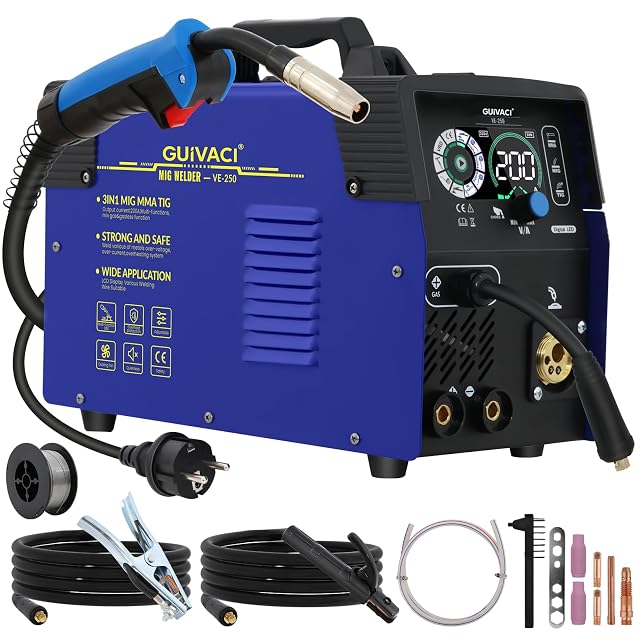
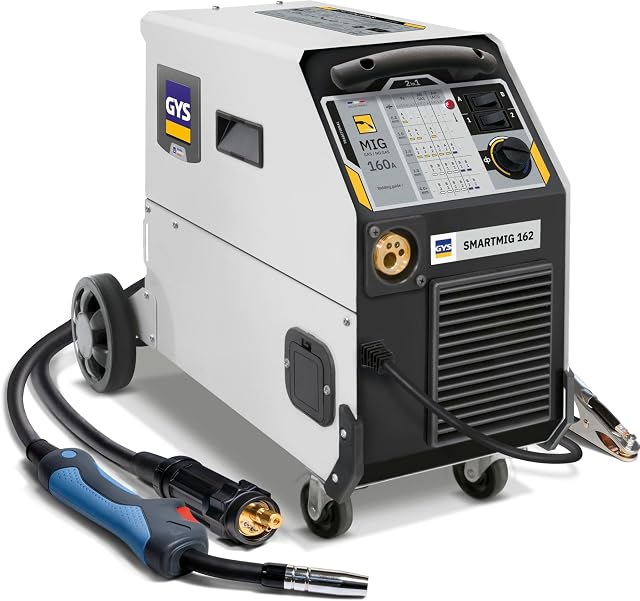
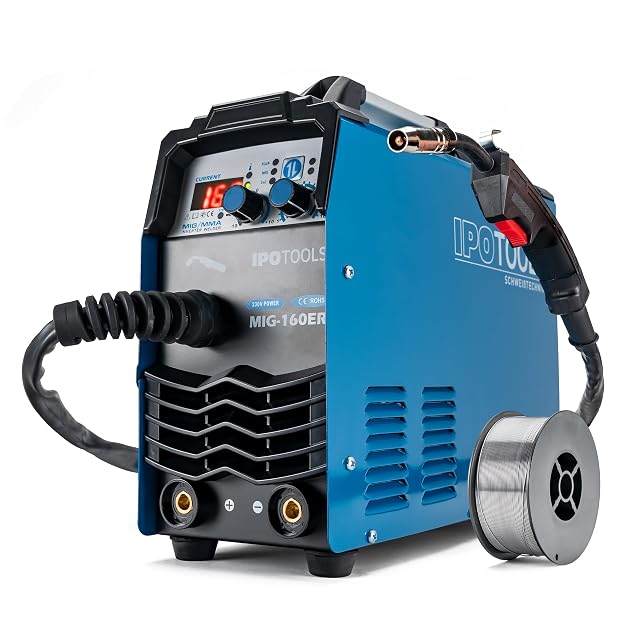
The bottom line The cheapest machine here that gives you the two controls that matter — synergy and inductance — with one product reference across all six markets.
The MIG/MAG 200 ST sits where most workshops end up: enough current for anything a home fabricator will build, and a control set that does not fight a beginner. The specification that makes it worth its price over the cheaper 160 A machines is not the extra amperage — it is the continuously adjustable inductance, which almost nothing else at this level offers.
What the numbers mean
Two hundred amps is a ceiling. STAHLWERK publishes the figure without a duty cycle at a stated temperature, which is the industry norm and tells you nothing about how long you can hold it. Treat it the way you would treat a car’s top speed: real, occasionally reached, not the number that describes daily use. For 3 to 6 mm steel — the range most of this machine’s owners work in — you will be somewhere between 90 and 140 A, and duty cycle stops being a limit.
The synergic control is the part that changes the first weekend. You dial in the current, and the machine derives the wire feed speed from it. That does not make the weld good, but it puts you inside the window where technique starts to matter, instead of leaving you to discover that a wire speed twice too high produces a bead that sits on the surface and fuses nothing.
The gasless question
The FLUX function lets the machine run flux-cored wire with no gas bottle, which is what makes outdoor work possible — a gas shield is blown away by any breeze worth the name. Two things to know before ordering wire: the polarity has to be reversed for flux-cored, and the resulting weld is dirtier, with slag to chip off. It is a genuine capability, not a marketing line, but it is not the same job as MIG under gas.
Where it stops
There is no pulse mode. Aluminium is possible with a spool gun through the Euro connector, and it is not the machine’s natural work — soft aluminium wire buckles in a long liner, which is exactly what a spool gun exists to avoid. If aluminium is the reason you are buying, look at a pulse machine or a TIG set instead.
Sources
Current, processes, synergic control, inductance and the FLUX function come from the manufacturer’s published specification. The product reference is verified on all six markets, judged on the EAN rather than on the translated title.
What we like, and what we don't
Strengths
Synergic control: you set the material and thickness, the machine sets the wire speed
Adjustable inductance — rare at this price, and it is what flattens spatter on thin sheet
One reference and one EAN across all six markets, so parts and support match wherever you are
Compromises
The duty cycle is not stated with its temperature in the listing, so 200 A is a ceiling, not a working figure
Gasless flux-cored work needs the polarity reversed, which the manual covers and the box does not
No pulse mode: aluminium is possible with a spool gun, not comfortable
Specifications
Maximum current
200 A
Processes
MIG/MAG under gas, gasless flux-cored
Wire feed
Fully synergic — feed speed follows the current setting
Inductance
Adjustable, continuously variable
Part number
1016
Amazon reference
B0DT9P7L4F (identical on all six markets)
EAN
4260294080164
Questions people actually ask
What does « synergic » actually change?
It removes one of the two settings you would otherwise get wrong. On a manual machine you set voltage and wire speed independently, and most beginners run too much wire, which piles metal on the surface without fusing it. A synergic machine derives the wire speed from the current you dial in, so the starting point is close to correct and you fine-tune from there rather than hunting.
Is the adjustable inductance worth anything on a hobby machine?
On thin sheet, yes. Inductance smooths the rate at which current rises when the wire short-circuits into the pool. Too little and the arc crackles and throws spatter; too much and it becomes sluggish and cold. Most machines in this price bracket fix it internally, so having the control is what lets you quieten the arc on car-body steel instead of accepting the spatter.