The bottom line The right answer if you weld outdoors, and a dead end if you later want gas.
Most welders in this price band advertise that they can work with or without gas. This one deliberately does one of the two. It is a flux-cored machine only — there is no gas valve, no regulator connection and no bottle — and for a particular kind of work that is the correct machine to own.
Why anyone would choose the limitation
A gas shield is a column of argon or a mix held over the weld pool. Outdoors, a light breeze pulls it away and the weld goes porous, and no amount of turning the flow up fixes it — more gas past a certain point pulls air in rather than pushing it out. Flux-cored wire carries its own shielding inside the wire, so it works in the wind. If your welding happens on gates, fence posts, trailers and machinery in a yard, this is not a compromise; it is the process that suits.
The second saving is the bottle itself. Renting a cylinder carries a standing charge whether you weld or not, and a bottle is a heavy, pressurised object that needs securing and storing. Removing it from the equation is worth more than the price difference between this machine and a dual one.
What you get for €200
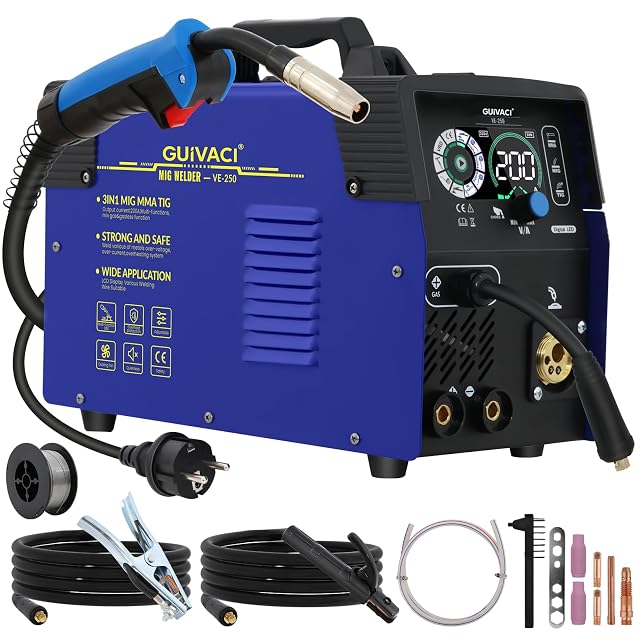
Synergic feed — you set the current and the wire speed follows — and a digital display, which is unusual at this price and useful mostly because it lets you write down a setting that worked and return to it. Three processes: flux-cored, stick and lift TIG. As with every lift TIG machine in this class, that last one means scratch-starting a tungsten, which is usable and is not a TIG set.
The trade you are accepting
Slag. Every flux-cored bead comes out under a layer of it, and it has to be chipped and wire-brushed before painting or before welding over. Spatter is heavier than with gas, so anything cosmetic will need dressing with a flap disc. Budget for both when you plan a job — the welding is quick and the cleaning is not.
Sources
Current, processes, synergic feed, display and part number come from the manufacturer’s published specification. Market availability was verified per market on the EAN; the reference was not live on the American store at the time of checking.
Prices quoted in this text were read on 2026-08-13. The live price is at the top of the page.
What we like, and what we don't
Strengths
No gas bottle to rent, fill, store or carry — the running cost is wire alone
Works outdoors, where a gas shield is blown away by any real breeze
Synergic feed and a digital display at €200
Compromises
Gasless only: you cannot fit a bottle later and weld clean MIG with it
Flux-cored wire leaves slag to chip and more spatter to dress than gas MIG
Not sold on the American market at the time of checking
Specifications
Maximum current
160 A
Processes
Gasless flux-cored, MMA, lift TIG
Wire feed
Synergic — feed speed follows the current
Display
Digital
Part number
6943
Amazon reference
B0G8KBG41Z
EAN
4262452499436
Questions people actually ask
What does gasless welding actually cost you in quality?
A dirtier weld and more cleaning up. Flux-cored wire carries its shielding in the core, and that flux becomes slag on top of the bead, which has to be chipped and brushed off before painting or before the next pass. Spatter is heavier too. The weld itself, laid properly, is sound — this is how a great deal of structural steel is welded on site.
Can I add a gas bottle to it later?
No, and that is the honest limit of this machine. It has no gas solenoid and no gas connection, so there is nothing to attach a regulator to. A machine sold as MIG/MAG with a FLUX function can do both; a FLUX machine can only do one. If there is any chance you will want clean, spatter-free welds indoors, buy the dual machine instead.